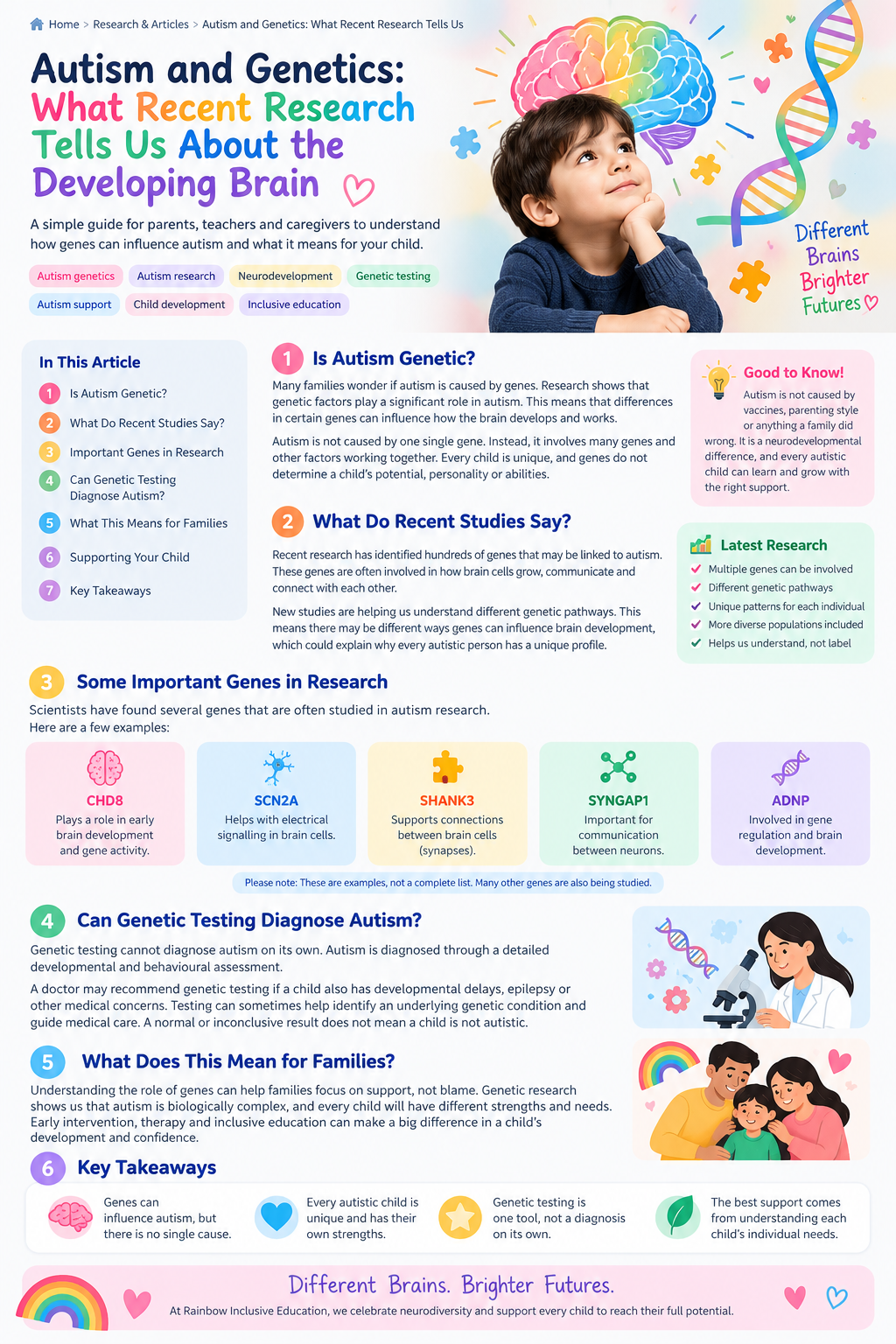
When parents first hear the word autism, questions often arrive all at once. Why does my child communicate differently? Is autism inherited? Could a test explain what we are seeing? Genetics research offers some answers, but it also reminds us how individual every child is.
Is autism genetic?
Genes play a substantial role in autism. But autism is not usually traced to one gene or one straightforward inheritance pattern. Many genetic differences can contribute, sometimes alongside other developmental influences. Some variants are inherited, while others arise for the first time in a child.
A large population study published in 2019 estimated autism heritability at about 80%. This is a statistical estimate across populations, not a percentage that describes any one child's autism. It is also not a way to predict what a child will learn or achieve.
What are autism-related genes?
Scientists study genes that help guide early brain development and communication between nerve cells. Some examples are CHD8, SCN2A, SHANK3, SYNGAP1 and ADNP. Certain variants in these genes are associated with autism or other neurodevelopmental conditions. Yet a gene name alone does not tell a family's whole story: the effects can vary considerably.
What has recent autism research discovered?
Recent studies suggest that different combinations of genetic influences may be associated with different developmental profiles. Rather than searching for a single explanation for all autistic people, researchers are investigating how multiple biological pathways shape development over time.
A 2025 Nature Genetics study described four research-derived groups with distinct developmental and genetic patterns. These are not four new medical diagnoses. Another 2025 study in Nature examined how genetic differences relate to age at autism diagnosis. Such findings are promising for research, but they cannot reliably predict an individual child's future.
Can genetic testing diagnose autism?
No. Autism is identified through a clinical developmental assessment that considers communication, interaction, behaviour and developmental history. Genetic testing may sometimes identify a related genetic condition or reveal medical considerations, especially when a child also has seizures, significant developmental delays or other health findings.
Parents considering testing should speak with a qualified clinician or genetic counsellor about which test is appropriate, what results might mean and what limitations to expect. A result that finds no clear genetic explanation does not rule out autism.
What does this mean for children in classrooms and therapy?
For parents and educators in Lahore and across Pakistan, the practical message is reassuringly simple: support should respond to a child's real needs, not a gene label. One child may benefit from picture-based communication. Another may need support with sensory regulation, classroom transitions, speech clarity or social participation.
Useful supports can include speech and language therapy, augmentative and alternative communication (AAC), occupational therapy when appropriate, visual schedules, structured teaching and respectful, individualised behavioural approaches. Goals should be meaningful to the child and family, with progress reviewed over time.
Three common misunderstandings
- “One autism gene causes autism.” There is no single gene that explains autism as a whole.
- “A genetic test tells us how capable a child will be.” It cannot predict an individual's learning potential or quality of life.
- “Autism is caused by bad parenting or vaccines.” Neither claim is supported by credible scientific evidence.
Where is autism genetics research going next?
Researchers are working to understand genetic pathways more precisely and to improve care for associated medical conditions. Another priority is including families from a wider range of backgrounds, because research populations have not always represented the world's diversity. Families in South Asia deserve research that reflects them too.
A final thought from Rainbow Inclusive Education
Science helps us ask better questions. It does not define a child's worth. Whether a child speaks, signs, uses pictures or communicates in another way, they deserve to be understood and included. The most useful starting point is always the same: notice their strengths, listen to their needs and make room for them to learn.
Rainbow Inclusive Education — Lahore
We support children and families through individualised learning and therapeutic services in Johar Town, Lahore.
Contact our team · Explore speech therapy · More parent resources
Research references
- Bai D, et al. (2019). Association of Genetic and Environmental Factors With Autism in a 5-Country Cohort. JAMA Psychiatry. Read study.
- Nature Genetics (2025). Research on genetic programs and autism diversity. Read study.
- Nature (2025). Research on genetics and age at autism diagnosis. Read study.
Educational information only; not a substitute for medical advice, diagnosis or genetic counselling.